


BLOG
Contents
Why Analog Records Won’t Disappear as AI Advances
We live in an age where almost everything is optimized and made more efficient through digital technology.
Music, work, and communication are all being streamlined, gradually converging toward an average.
Everything is convenient, fast, and free of waste.
We are surrounded by an environment that is more refined than ever before.
The world of music is no exception.
With the advancement of AI, music can now be easily generated simply by specifying a genre or mood.
The results are highly polished and rarely flawed.
Whenever we want, the music we want is instantly available.
It is a rational and highly efficient evolution.
And yet, I feel that the more technology advances, the less likely analog records are to disappear.
No matter how far technology progresses, human beings themselves have not fundamentally changed for millions of years.
From the tips of our heads to our fingertips, we remain imperfect, emotionally driven, and constantly fluctuating.
If anything, we tend to make decisions based more on emotion than on logic.
That fact will not change, no matter how sophisticated technology becomes.
As technology advances, the value of analog seems to rise in relative terms.
In an era where music can be generated endlessly by AI, the background of who created it and how it was created—along with the atmosphere shared in a live performance—becomes a value in itself.
The traces left by human thought, hesitation, and judgment.
There may even be mistakes along the way.
All of that is physically engraved into an analog record.
It is not perfect, but precisely because of that, we can feel the presence of the human behind it.
The experience of analog records themselves is also deeply human.
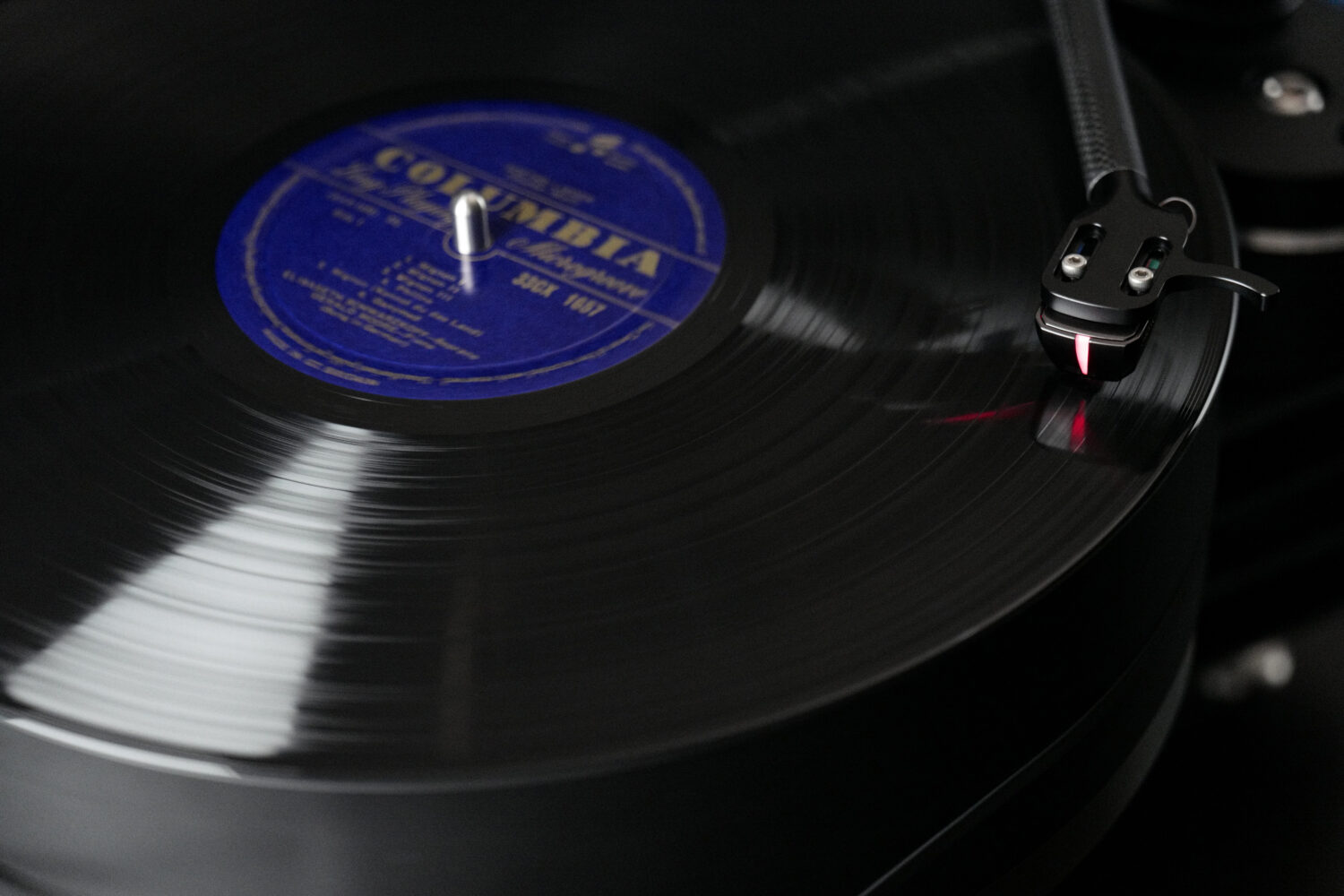
Taking a record from its sleeve, lightly wiping the surface, and placing the needle down.
Once playback begins, there is no fast-forward—only 20 to 30 minutes of uninterrupted listening.
The faint scent of paper from the jacket, reading the liner notes as the music plays.
None of these actions are efficient, but they are profoundly human.
In a future where everything is made more efficient through technology,
experiences that allow us to feel this sense of “human-ness,” such as listening to analog records,
will become increasingly valuable.
This is not limited to analog records alone.
As technology continues to advance, meeting people in person will become more precious.
Holding hands, sharing laughter in the same physical space—these moments will take on greater meaning than ever before.
In musical terms, the value of sharing sound within the same space will continue to grow.
Going to a live performance and immersing oneself in real sound.
There is no optimization or averaging there, only genuine warmth and presence.
People will increasingly seek out these kinds of experiences.
Another reason lies in the way technology increases our discretionary time.
There was a time when people had to spend most of their lives engaged in farming simply to survive.
With the advent of machinery, humanity was freed from much of that labor and gained time for other pursuits.
If that was an extension of our physical strength, then the widespread adoption of AI can be seen as an extension of our cognitive capacity.
As tasks become more efficient, time is created.
A working life where a two-day weekend is the norm may soon give way to a world
where a three-day weekend is no longer unusual.
So what will people do with this newly created time?
Most likely, it will be integrated into daily life as time devoted to personal interests and hobbies—
time spent purely for oneself, separate from efficiency and productivity.
As someone involved in an industry built around hobbies—
an industry that cannot exist without people having discretionary time—
I find this shift deeply encouraging.
No matter how far technology advances, it is still human beings who listen to music.
Analog records quietly continue to remind us of this simple truth.
And the sensation of placing the needle on a record and finding it comforting—
that feeling, I believe, will never change.